
Somewhere right now, creators are staring at a blank screen with a video fully formed in their head — the shot, the character, the punchline, the exact three seconds that would make someone stop scrolling. And then the moment passes, because turning that idea into an actual video means learning software, coordinating a production team, or blocking out a weekend that never comes.
This is the quiet failure point of content creation: it was never a shortage of ideas. It was always a shortage of ways to execute them fast and conveniently enough for them to still matter.
A new category of software is emerging to bridge this gap: AI creative platforms bring together multiple smart AI tools for images, videos, and audio, along with templates and creative guidance, to help users turn a plain-language idea into finished content within a connected workflow. This article explores what defines an AI creative platform, how it differs from single-function AI tools, and what this shift means for creators and brands.
The Old Bottleneck: Having an Idea Is Easy, Executing It Perfectly Isn’t
Why a great idea rarely survives the traditional production process
Traditional video production is a relay race with a lot of handoffs: scripting, storyboarding, casting or character design, filming or animating, editing, sound design, and revision after revision.
Each handoff is a place where an idea can lose momentum — or lose its original vision entirely.
The real gap — skills, tools, and time between “what you imagine” and “what you can actually make”
The distance between concept and finished product usually comes down to three missing resources:
- Skills — storyboarding, animation, editing, and sound design are specialist crafts that take years to learn
- Tools — professional-grade software has a steep learning curve, even before a single frame is produced
- Time — a polished video can take days or weeks, while social platforms reward teams that can publish within hours
This is why HubSpot’s 2026 data ranks short-form video as the highest-ROI content format, cited by 49% of marketers, even as many of those same teams say they can’t produce it fast enough to keep up with demand.
What Is an AI Creative Platform?
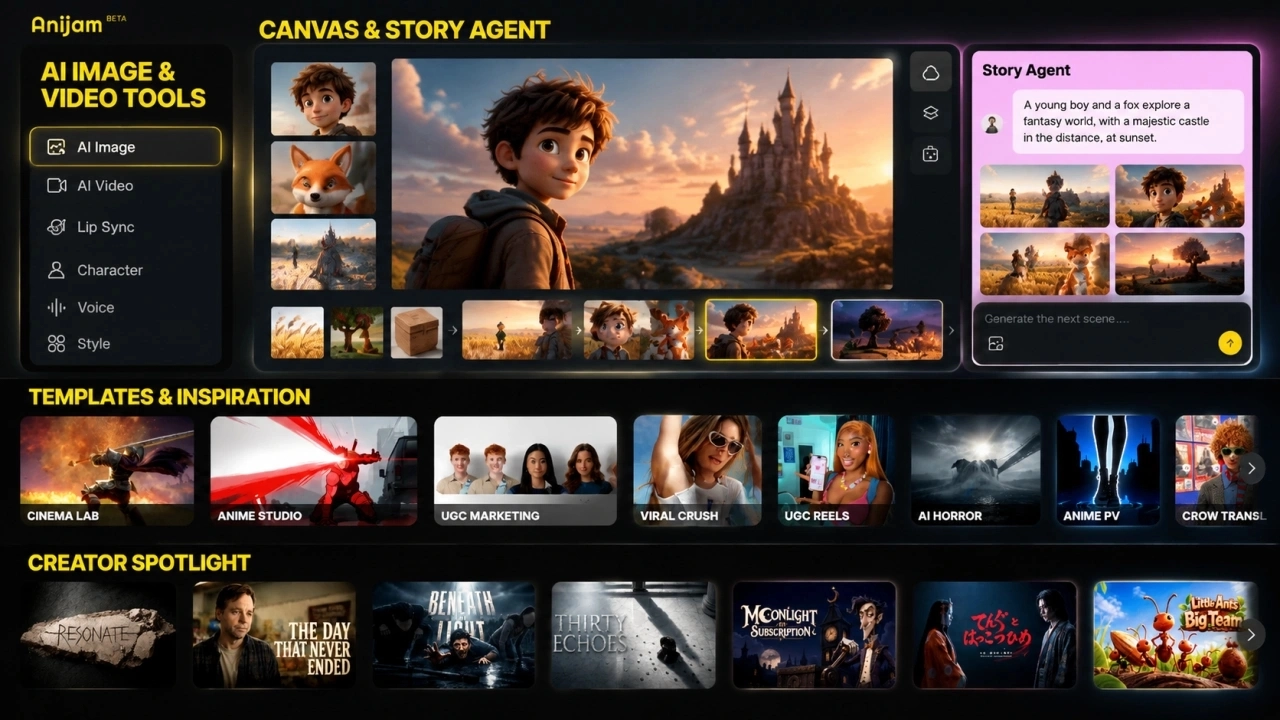
An AI Creative Platform is a digital workspace that brings together multiple AI-powered creative capabilities, such as image, video, and audio generation, along with templates and creative guidance. Rather than focusing on a single task, it helps users explore ideas, create different types of content, and refine their work within a connected environment.
From Single-Function AI Tools to Connected Creative Workflows
The Core Capabilities of an AI Creative Platform
Some AI tools focus on one specific task: generating a voice-over, adding captions, removing a background, or creating a single video clip. Each can be useful on its own, but creating a finished video often means moving between multiple tools and manually combining their outputs.
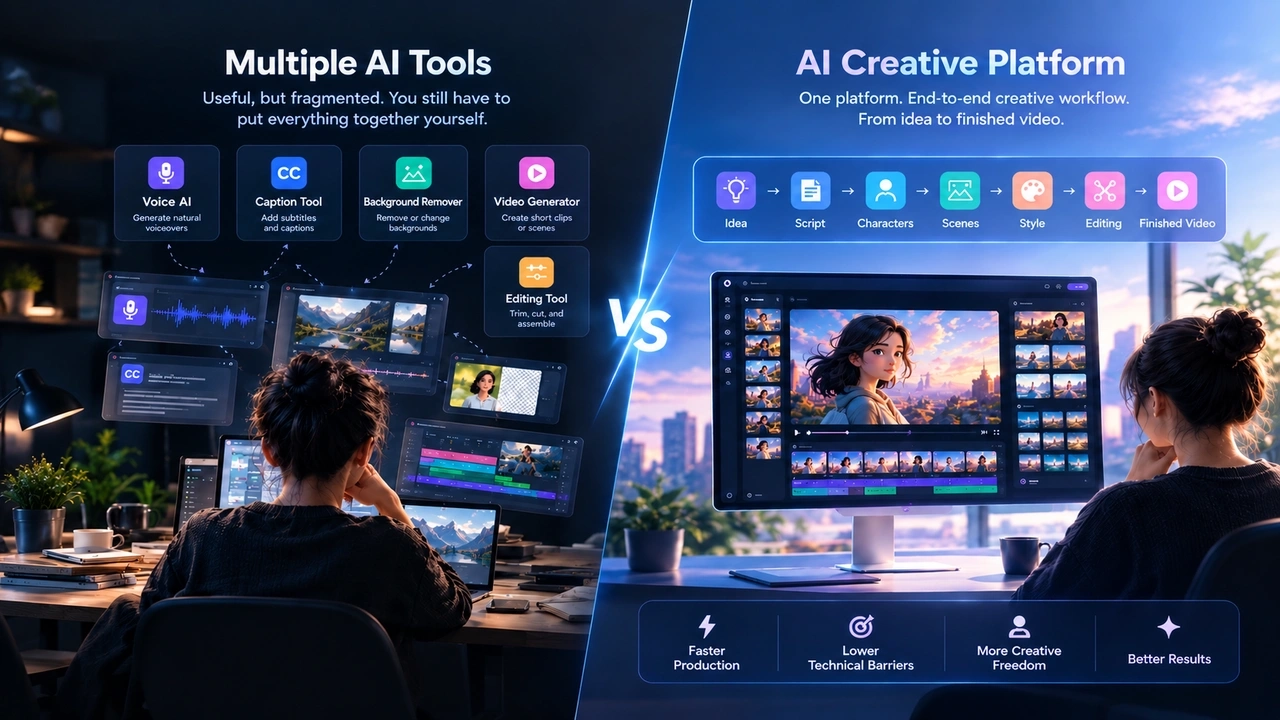
An AI creative platform brings these capabilities into one workspace. Platforms differ in scope, but most are built around five core capabilities:
- Multi-model access: Offers a choice of AI models, in-house or from third parties, so users can pick the right one for a given goal, style, or output without searching for each model separately.
- Multi-modal creative tools: Covers different types of creation, such as image generation and editing, video generation and editing, voice, music, and sound effects. The exact range depends on the platform’s focus.
- Templates and creative inspiration: Provides preset templates, style examples, and inspiration libraries that help users discover directions and start faster.
- Creation and refinement workflows: Connects prompting, asset generation, scene organisation, editing, and iteration. On video platforms, this can extend to storyboards, character consistency, lip-sync, and timeline editing.
- Discovery and community: Lets users see how others create through showcased work, shared workflows, and trending content, then turn that inspiration into their own projects.
Together, these capabilities are meant to reduce switching between tools and make it easier to start a project and keep refining it. Not every platform covers all five equally; the mix depends on its primary use case.
How Different AI Creative Platforms Approach the Workflow
Platforms emphasise these capabilities in different ways. Some begin from a text prompt or a conversation, others from templates or existing footage, and they combine generation and editing differently. Based on a review of popular platforms’ available features and workflows, the table below compares their typical starting points, core creative features, free tier, refinement and use cases for AI video creation.
| Platform | Typical Starting Point | Core Creative Features | Free Tier | Editing and Refinement
|
Use Cases |
| Anijam AI | Text prompts
|
One Workspace(One Canvas)
|
Yes: free sign-up credits and daily check-in bonuses
|
Prompt-based refinement
|
|
| Runway | Text prompts
|
AI image, video, and audio generation
|
Yes: one-time credits | Offers AI-powered video editing, timeline editing, and customisable workflows | Social media videos
|
| Google Flow | Text prompts
|
AI filmmaking with video and image generation
|
Yes: limited daily credits (do not roll over) | Provides tools to extend, arrange, and refine shots within a filmmaking workflow | Short films
|
| CapCut | Ready-made templates
|
AI-assisted video creation
|
Yes: basic AI tools and simple video templates at no cost | Offers a broad range of editing tools, including transitions, filters, captions, and AI-assisted edits | Short-form social media videos
|
The differences are not simply about which platform offers the most features. They also reflect different approaches to creative work: some emphasise cinematic scene generation, others combine AI generation with conventional editing, while conversational video agents help coordinate multiple stages of production from an initial idea to a finished video.
What You Can Actually Create with AI Creative Platforms
Narrative and Story-Driven Videos
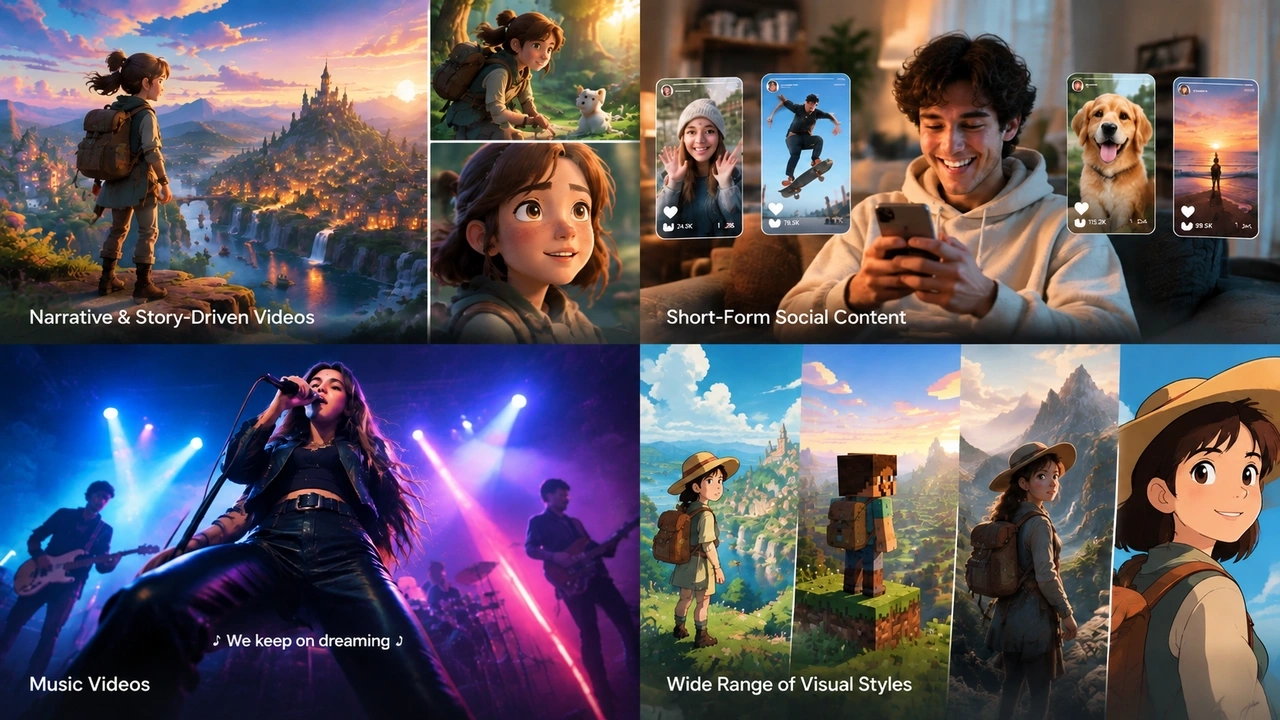
AI Creative Platforms are making it easier for creators to turn story ideas into visual narratives. Rather than producing isolated clips, creators can use these platforms to explore visual concepts, develop scenes, and bring different shots together into a coherent story. A notable example is Air Head, a short film created in 2024 by Toronto-based creative team Shy Kids. Built around the unusual idea of a man with a balloon for a head, the film demonstrates how an imaginative concept can be developed into a complete visual story. For creators working on similar projects, AI Creative Platforms offer a way to experiment with scenes and visual ideas before refining the footage through editing and visual effects.
Short-Form Social-First Content
For creators making videos for TikTok, Instagram Reels, and YouTube Shorts, AI Creative Platforms can help simplify the journey from an initial idea to a shareable video. Creators can start with a prompt, explore different visual directions, and use templates or guided workflows to shape content for short-form formats.
These platforms are especially useful for trend-driven videos, where speed and experimentation matter. Instead of building every video from scratch, creators can adapt an existing concept, test different looks, and refine the result to suit their audience and platform.
Music Videos
Music videos give creators room to experiment with visual storytelling, surreal imagery, and a distinctive atmosphere. AI Creative Platforms can support this process by helping creators explore visual concepts, generate footage, and develop a consistent creative direction for a track.
One example is The Hardest Part, a 2024 music video for Washed Out directed by Paul Trillo. Trillo reported that approximately 700 generations were needed to produce the 55 shots used in the final video. The project highlights the value of iteration in AI-assisted creative work: creators may need to explore many possibilities before finding the shots that best express a song’s mood. AI Creative Platforms can help make this kind of visual experimentation more accessible within the creative workflow.
A Wide Range of Visual Styles
AI Creative Platforms also give creators more ways to explore visual styles without having to build every effect or scene manually. Depending on the platform’s capabilities, creators can experiment with looks such as 2D animation, cinematic 3D, anime-inspired visuals, paper-craft aesthetics, or surreal, dreamlike environments.
This flexibility is useful for creators who want to establish a recognisable visual identity or adapt their content to different audiences. Rather than committing to the first idea, they can compare different creative directions, refine the one that works best, and develop a more distinctive visual style across their videos.
Why This Matters for Creators, Brands, and Marketing Teams
Lower barrier to entry for solo creators and small teams
A solo creator or a two-person marketing team no longer needs an in-house animator, editor, and sound designer to produce something that looks professionally made. The skill requirement shifts from “years of production training” to “being able to describe what you want.”
Faster iteration for social-first, trend-driven content
Short-form platforms reward speed. Sprout Social’s 2026 Content Strategy Report found that 52% of Instagram users now gravitate toward video under 60 seconds, and trends move fast enough that a video finished a week later has often missed its moment. Compressing the idea-to-publish cycle from days to minutes is a genuine competitive advantage, not just a convenience.
Scaling video output without scaling headcount
For marketing teams, this is arguably the biggest shift. Instead of hiring specialists for every new video format or platform requirement, teams can multiply their output using the same headcount — which matters given that, per Wyzowl, 91% adoption of video as a marketing tool means simply having video no longer sets a brand apart. Volume and speed increasingly do.
Final Thoughts
The gap between “I have an idea” and “I have a finished video” has defined content creation for decades. AI creative platforms are the first real attempt to close that gap at the level of the entire workflow, not just one step in it.
AI Creative Platforms are evolving beyond simple content generation. By bringing together creative ideation, image and video generation, customisable templates, and editing tools, they help creators move from an initial concept to a more polished final video within a connected workflow.
As these platforms continue to develop, their value will depend not only on the content they can generate, but also on how flexibly creators can shape their ideas, combine different creative elements, and turn rough concepts into finished work. For creators and teams navigating an increasingly fast-paced content economy, this evolution could reshape how video content is imagined, produced, and refined.