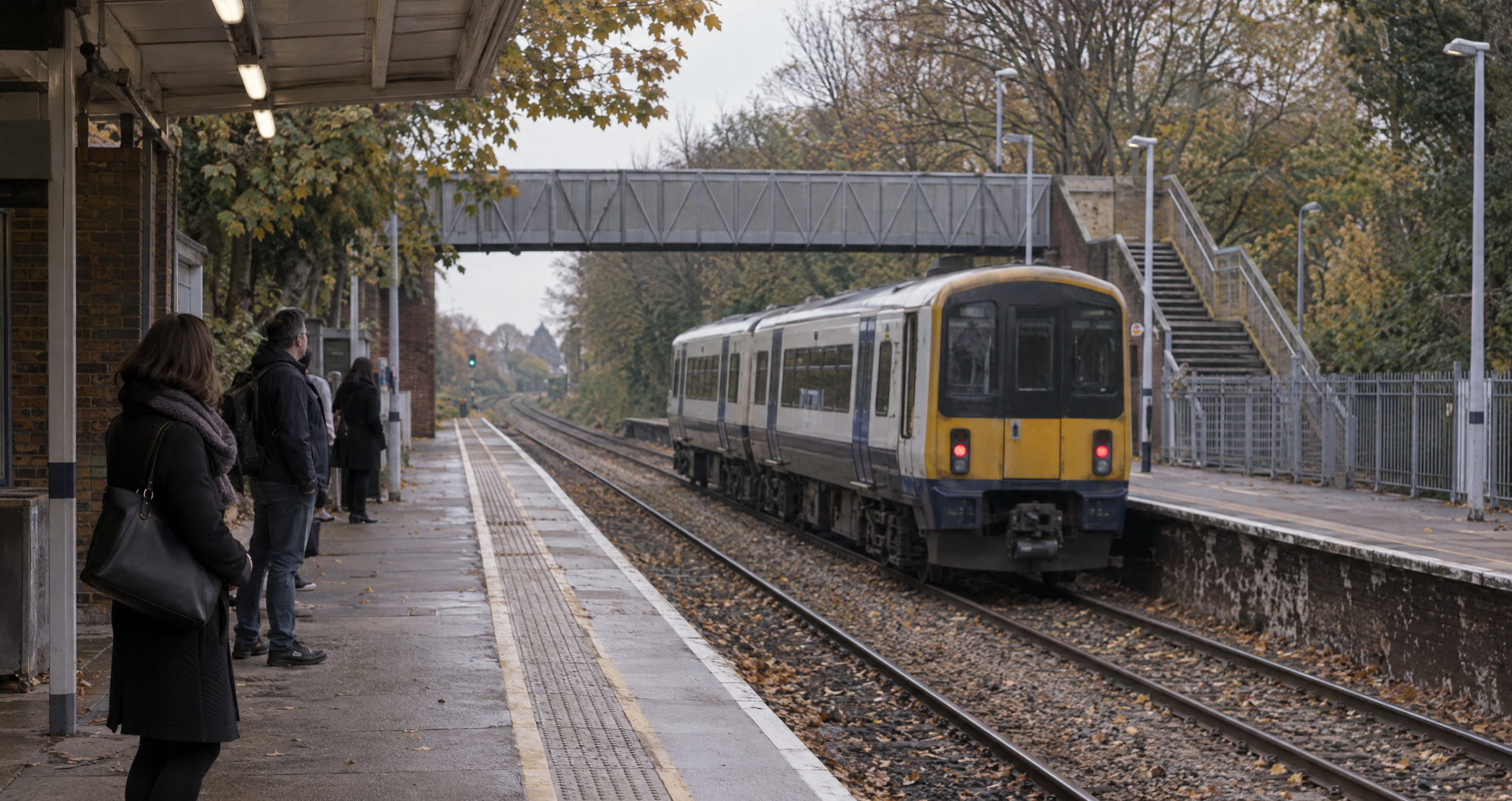

Great Northern will double its off-peak service between Moorgate and Hertford North from Monday 14 December, when the winter timetable takes effect, restoring four trains an hour on weekdays and Saturdays.
The additional trains run until about 9pm towards London and until about 8pm towards Hertford North. Outside those hours the timetable is unchanged, so late-evening passengers will see the existing pattern rather than the improved one.
Sunday services are not part of the change. The four trains an hour apply from Monday to Saturday, so Sunday travellers keep the present frequency.
The new timetable is the first in more than six years to take the Hertford Loop above a half-hourly off-peak frequency. The route has run two trains an hour off-peak throughout that period, so the change doubles the service rather than adjusting it at the margin.
Two stations left out
Bayford and Crews Hill will not be served by the extra trains. Both keep a half-hourly service on the Stevenage to Moorgate route, so passengers there see no reduction, but they also see none of the additional capacity going to neighbouring stations. Travellers there will find the same pattern of trains while stations either side of them gain two extra services an hour.
Because the new services omit those stops, they will complete the run into London three to four minutes faster than the trains they supplement. The gain is modest in absolute terms, and it comes at the cost of a slightly uneven calling pattern, with some stations receiving all four trains an hour and others two. Passengers making the whole journey to Moorgate gain most, while those travelling only a few stops gain very little.
For a regular traveller the saving compounds. Two journeys a day, five days a week, adds up to a meaningful amount of time across a month, even though no single trip feels appreciably quicker.
The change requires no new track, signalling or rolling stock. It is delivered by using existing trains and paths differently, which makes it unusual among improvements on the commuter network, where extra services normally follow years of infrastructure work.
The wider contest
Transport for London is separately bidding to take over the Great Northern Moorgate route, known as the Northern City line. That bid is a live question about who operates the service, and the timetable change sets out what the current operator intends to offer in the meantime.
The two issues are connected for passengers, because a transfer of responsibility would settle the future of the route’s service pattern as well as its management. Great Northern’s improvement takes effect first, so the timetable in place at the point of any transfer becomes the benchmark.
A service increase of this kind is also difficult to withdraw once passengers have arranged their working days around it. That gives the current operator an interest in the outcome of the transfer question as well as a timetable to run in the meantime.
For commuters between the two termini the practical change from 14 December is a train roughly every 15 minutes through the middle of the day, which shortens waits for anyone travelling outside the peaks and makes a missed service a smaller inconvenience. Passengers at Bayford and Crews Hill keep the timetable they have now.
Whether the frequency holds through the winter will depend on how the timetable performs once it is running in full, which the first weeks of the new schedule will show.