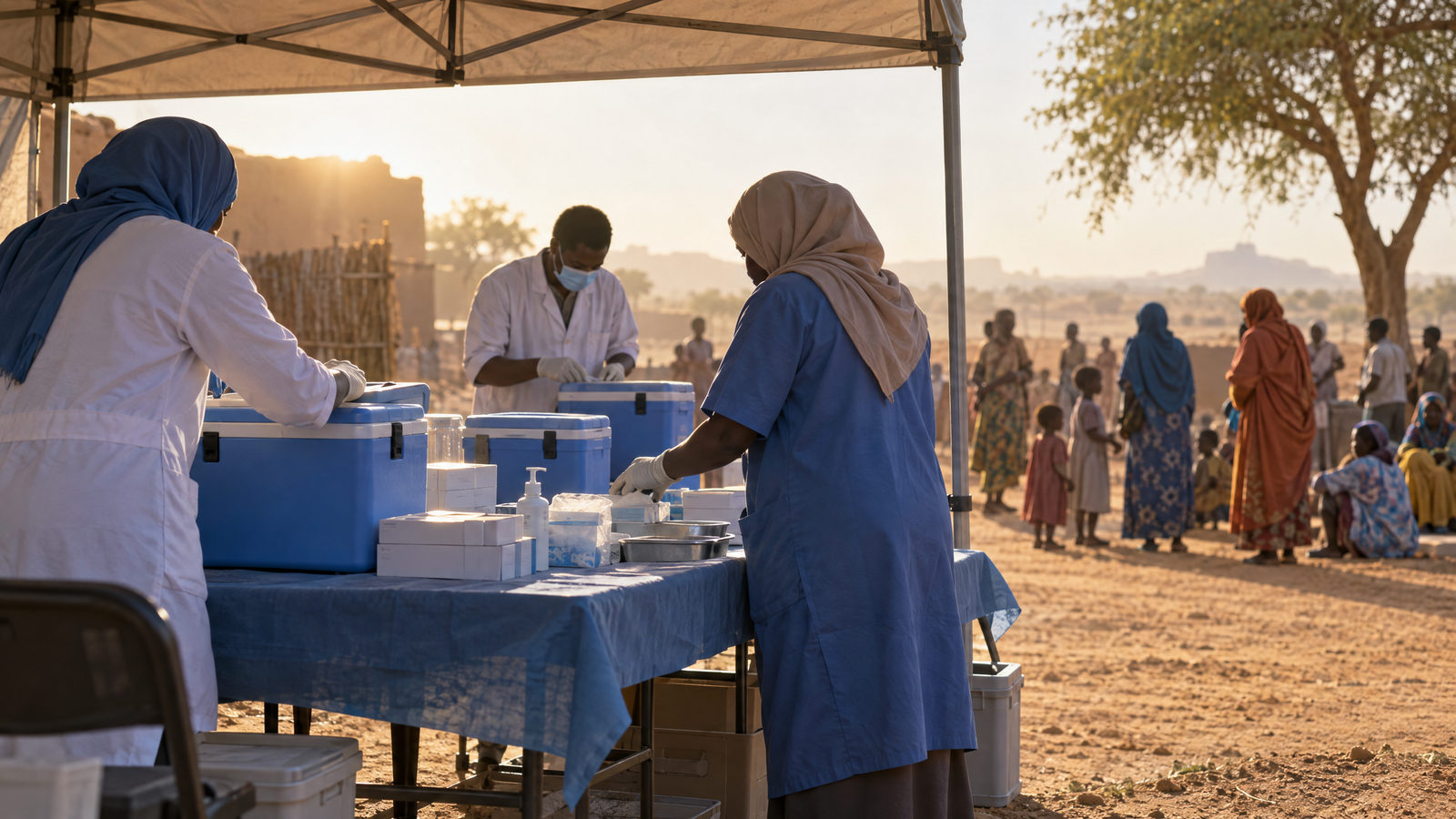

Italy has provided €3.5 million for emergency health work in Sudan, with the money intended to support disease control, public-health surveillance and catch-up vaccination for children whose routine immunisations were missed.
The grant is designed to strengthen work alongside Sudan’s Federal Ministry of Health during a conflict that has put hospitals, health workers and basic disease-monitoring systems under sustained pressure. More than three million people are expected to benefit from the planned programme, including more than 730,000 children identified for catch-up vaccinations.
Those figures describe the anticipated reach of the funding. They do not mean that the services, vaccinations or medical supplies have already been delivered, nor do they guarantee that every person named will be reached.
Funding aimed at prevention as well as treatment
The programme is expected to help prevent and control disease outbreaks, improve the capacity to detect and respond to health threats, and expand vaccination for children with no recorded routine doses. These are connected tasks. A functioning surveillance system can help health authorities spot unusual patterns of illness, confirm risks and direct limited staff, medicines and vaccines towards the places where they are most needed.
Catch-up vaccination is particularly important where conflict, displacement or the closure of local services has interrupted ordinary appointments. Children described as zero-dose have not received the routine immunisations expected earlier in life. Reaching them can require outreach beyond fixed clinics, as well as reliable supplies, trained staff, safe routes and the ability to keep vaccines at the required temperature.
The announcement does not specify which vaccines will be used, the locations of the planned work, a delivery timetable or how the €3.5 million will be divided between vaccination, surveillance, outbreak control and other emergency health activity. Those details will matter in judging how the grant is put into practice.
A health system operating under strain
Sudan’s health needs are shaped by far more than the immediate treatment of individual patients. More than 11 million people need urgent health care, while insecurity has made it increasingly difficult for staff, supplies and patients to move safely. More than two thirds of main hospitals in affected areas are out of service, and facilities still functioning face shortages of staff, medicines, safe water and electricity.
Disruption to surveillance adds a further risk. When laboratories, reporting routes or transport links are compromised, outbreaks can be harder to identify and contain. Support for surveillance and response capacity may therefore help health authorities act earlier, but its effect will depend on access, local staffing and the continuity of wider services.
The new grant is a defined contribution to that wider emergency effort, not a resolution of the health crisis. It is separate from assistance for other needs such as food, water, shelter and protection, even though each of those pressures can affect whether families are able to seek care or keep vaccination appointments.
What should be measured next
The most meaningful next evidence will be operational rather than ceremonial: whether funds are translated into functioning outreach, surveillance and response work in communities that can be safely reached. Useful future updates would set out where activities are taking place, which services have started, how many children have actually received vaccinations and whether local health teams have been able to investigate and respond to outbreaks more quickly.
Until then, the significance of the announcement lies in the additional funding and its stated priorities. The expected three-million-person reach and the target for more than 730,000 children are plans against an acute health emergency, not completed outcomes.