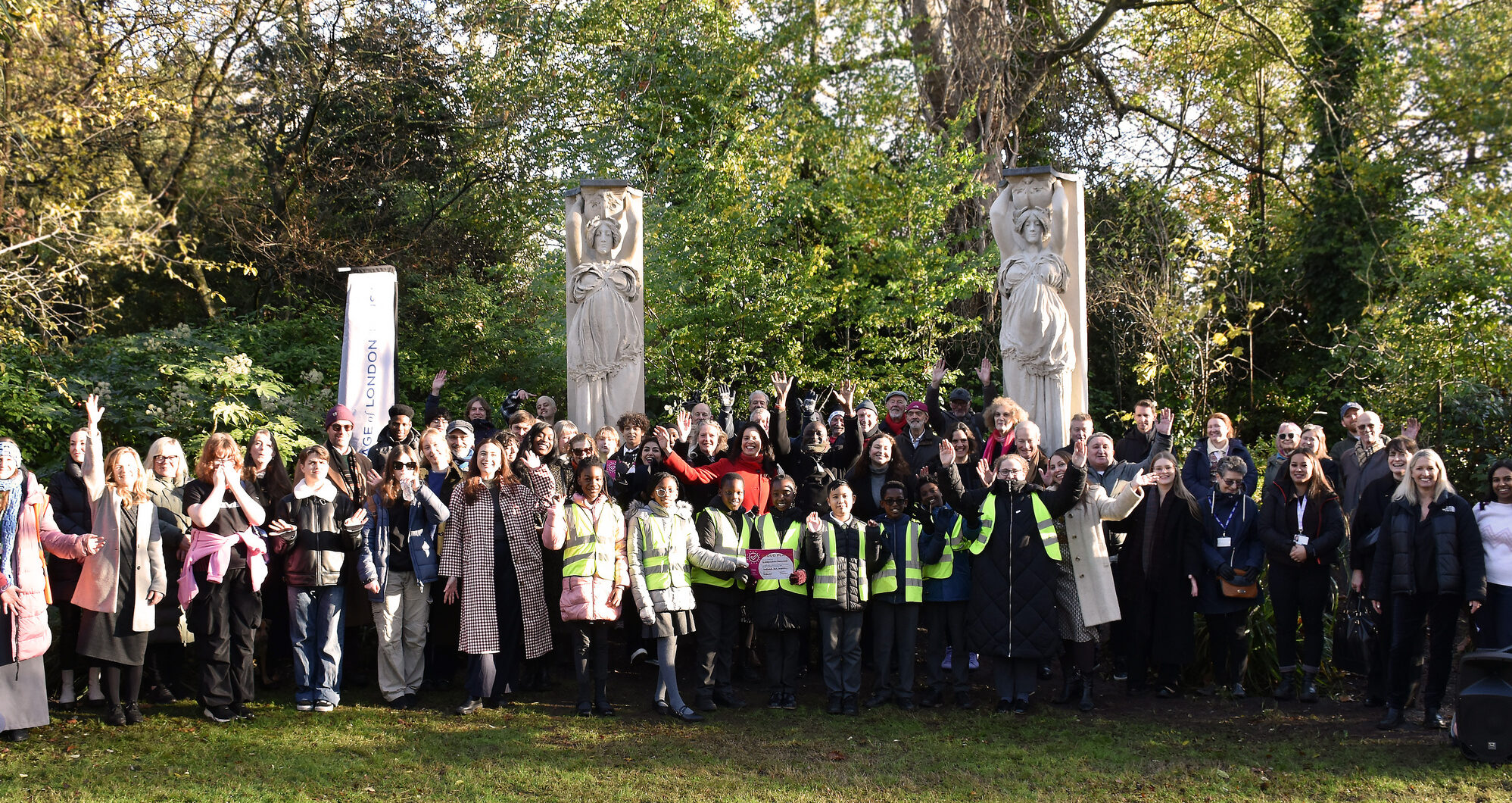

Southwark Park’s long lost caryatids stepped back into the spotlight on 3 December as they were unveiled following a major restoration by Heritage of London Trust and Southwark Council. Once battered by wartime bombs and shuttled across the borough through a century of change, the statues now stood renewed and ready to be celebrated by the community that helped bring them back to life.
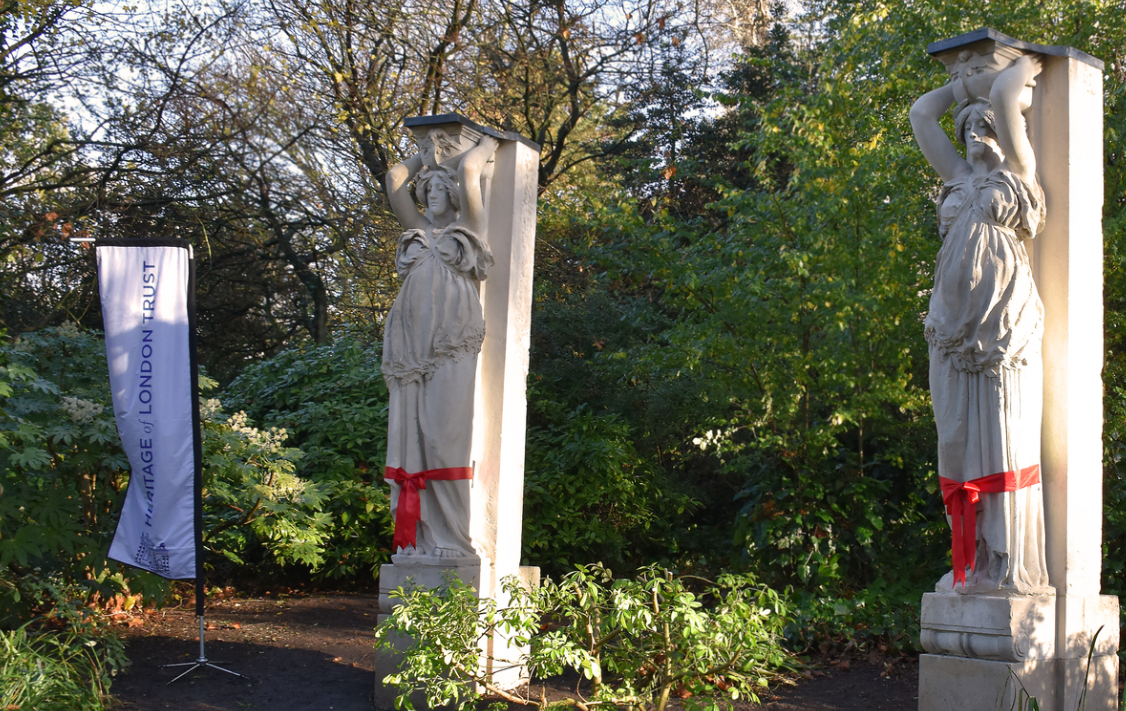
Mayor Sunny Lambe and Southwark Councillor Ellie Cumbo were part of the ribbon cutting along with local school children.
A remarkable journey through history
The two striking female figures had an extraordinary story. Originally created in 1897, they stood either side of the doorway to Rotherhithe Town Hall on Neptune Street, a grand Victorian civic building later converted into a library in 1905. During the Second World War the library was bombed six times, leaving it badly damaged. It was eventually knocked down. Against all odds, the caryatids were rescued and in 1974 found a new home on the brutalist Heygate Estate off New Kent Road.
When that estate was demolished in 2011, the statues were moved again to Southwark Park, which was supported by the Friends of Southwark Park.
About the restoration project
Now, more than a century after they were carved, the caryatids have been carefully restored thanks to Heritage of London Trust and Southwark Council. Conservators cleaned the statues and repaired missing features to the face, head and arms, modelling details in wax before recreating them in stone. Joints were repointed and flashing added on top of the sculptures to protect them from weathering.
The surrounding greenery was cut back so the figures could be fully appreciated and properly safeguarded in their setting. Crucially, the restoration involved the next generation through Heritage of London Trust’s Proud Places programme. One hundred and seventy five young people from local schools and youth groups met stonemasons on site, saw close up how heritage is cared for and deepened their understanding of the craft skills behind keeping historic alive.
Omar, aged 17, from Southwark College, gave a speech:
“My name is Omar and I am from Sudan. I’m part of the Proud Places programme. I enjoyed learning about the history of our sculptures and how they were part of old Rotherhithe Town Hall. My favourite part of the trip was seeing the statues up close and hearing the stories behind them. Learning about our local history is very important because it helps us understand how our community has changed. Look at them – they are beautiful!”
About the caryatids
Carved from Portland stone, the pair are masterpieces of the Arts and Crafts era. Each figure wears a classical costume, one garlanded with oak leaves, the other with laurel, and both balance the prow of a ship on their head, complete with a winged female figure at the bow symbolising Rotherhithe’s maritime heritage.
Their strong physiques and symmetrically parted hair tied in a bun reflect the bold style of the period which ran from the late nineteenth century into the early twentieth century. That both statues survived bombing, demolition and relocation not once but twice made their survival remarkable.
About sculptor Henry Poole
The caryatids are the work of Henry Poole, a celebrated figurative sculptor in bronze and stone who taught at the Royal Academy and served as Master of Sculpture from 1921 until his death in 1928. Poole’s public works once adorned buildings across Britain and abroad, from Westminster Central Hall and Deptford Town Hall to Cardiff City Hall and the bronze lions that once guarded the Shanghai headquarters of the Hong Kong and Shanghai Banking Corporation, now displayed in the Shanghai History Museum.
Londoners may have known his more playful work too, including the much loved comical bronze friars decorating the interior of The Blackfriar pub in the City. Much of Poole’s output had been lost or relocated as public buildings changed over the last century which made the Southwark Park caryatids all the more precious. This Heritage of London Trust restoration project was supported by Knight Frank.
Dr Nicola Stacey, Director, Heritage of London Trust said:
“These wonderful fragments of Southwark’s history have survived more than 100 years of disruption and loss. We’re thrilled to have restored them to their former magnificence so they can be enjoyed by the public – and at the same time highlight the work of a very fine but little-known Arts & Crafts sculptor.”
Councillor Ellie Cumbo, Cabinet Member for Parks and Culture, said:
“These historic caryatids are an extraordinary part of Southwark’s story, having survived bombs, demolitions and relocations to stand proudly in Southwark Park today. We are delighted to have worked with Heritage of London Trust and London Stone Conservation to ensure they are restored and protected for generations to come. It is especially exciting that local young people have been part of this project, learning new skills and connecting with the rich history on their doorstep.”
Stephen Clifton, UK Managing Partner, Knight Frank, said:
“Knight Frank is proud to support the fantastic work of Heritage of London Trust – restoring the historic buildings and places that give London such character. Southwark is steeped in history and it is a wonderful privilege to help it be shared in this way.”
Peter Wisby, age 86, local resident was enthusiastic:
“I must confess when I first saw the statues, I thought they were eventually going to topple over and when I see, in the Southwark news, that they were going to be restored, I thought brilliant. It’s been way too long, organisation like HOLT are brilliant to do it, because no one would have other than, maybe like volunteers like yourself.”