
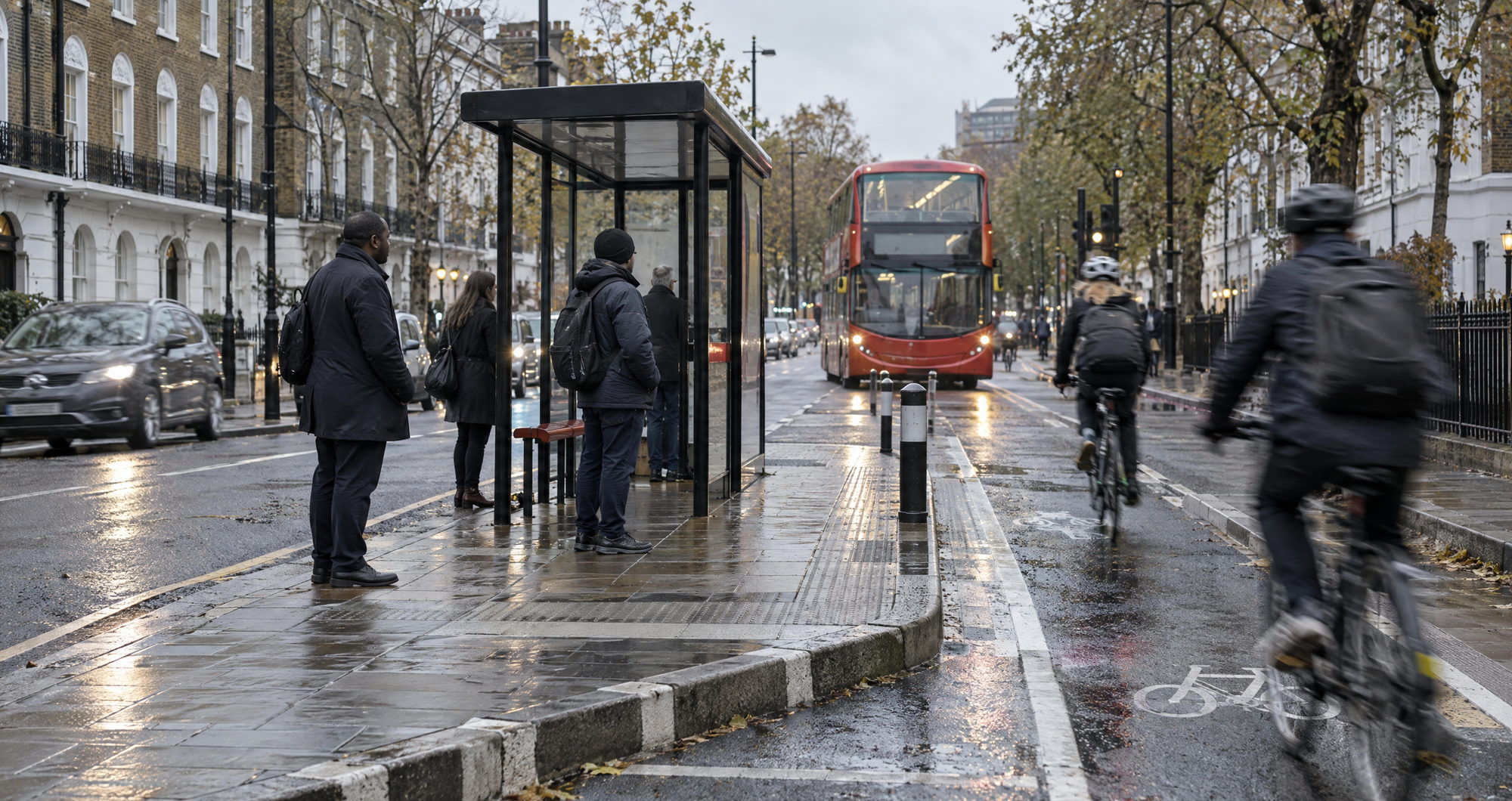

The London Assembly has called on the Mayor to stop installing and funding new floating bus stops until a safer design is agreed, after members heard evidence that blind, partially sighted, older and disabled passengers are being put at risk when they step off buses.
A motion proposed by Conservative assembly member Keith Prince was carried by 17 votes to three at the plenary session on 5 November. It asks Sadiq Khan to instruct Transport for London to pause the programme, which places the cycle lane between the pavement and the bus stop so that passengers must cross a bike lane to board or alight.
How the design works, and where it goes wrong
Floating bus stops, sometimes called bus stop bypasses, were introduced in London from 2013 as part of efforts to build continuous protected cycle routes. The stop sits on an island in the carriageway, with a ramped or level crossing over the cycle track connecting it to the footway. For people on bikes the arrangement removes the need to merge with general traffic. For passengers, it adds a second crossing at the exact moment a bus arrives and a crowd is moving.
During the debate, Mr Prince cited an incident on Haverstock Hill in Camden in August 2025, when a disabled man was knocked down by an e-bike rider while getting off a number 1 bus. He told members that the same problem had been raised with City Hall repeatedly without a change of approach.
Deputy Mayor for Transport Seb Dance, responding for the Mayor, described being punched in the face by a cyclist who did not wait for him at a floating bus stop. He did not dispute that conflict occurs at the crossings, but defended the principle of separating bikes from motor traffic on busy routes.
Counting the near misses
An observational survey discussed in the debate recorded 397 cyclists at three floating bus stop crossings and found that 33 gave way to pedestrians. Campaigners from the National Federation of the Blind of the UK supplied video of near misses, including at Lea Bridge in Waltham Forest, where a protected cycle route runs past a rebuilt bus stop.
Assembly members from several parties supported the motion, arguing that a pause is not a rejection of cycling infrastructure but a demand for a design that works for everyone who uses the pavement and the road. The three votes against came from members who said halting the programme would strand routes that are already half built and put cyclists back into heavy traffic.
What the pause would mean
The motion carries no legal force. The Mayor controls TfL’s investment programme and the boroughs control most of the roads where the stops are built, so a change of direction would require agreement across both. TfL has previously argued that removing floating stops from a route would either break the continuity of the cycle lane or push cyclists into a lane shared with buses and lorries.
Accessibility groups have been pressing for a national design standard rather than a London-specific fix. Their argument is that the current guidance relies on the behaviour of people on bikes, with give-way markings and raised tables that are widely ignored at peak times, instead of a physical layout that separates the crossing from the cycle track.
The assembly’s vote adds to a growing list of transport decisions where the capital’s cycling programme is being tested by disability, safety and motoring groups at the same time. The next step is for the Mayor to respond formally to the motion, and for TfL to say whether any schemes currently in design will be held back while a revised standard is worked up.
For passengers, the practical question is simpler. Where a floating stop already exists, boarding still means watching for bikes in both directions before stepping off the kerb, and the campaign groups want signs and road markings that make that obligation unmistakable until the design itself changes.







