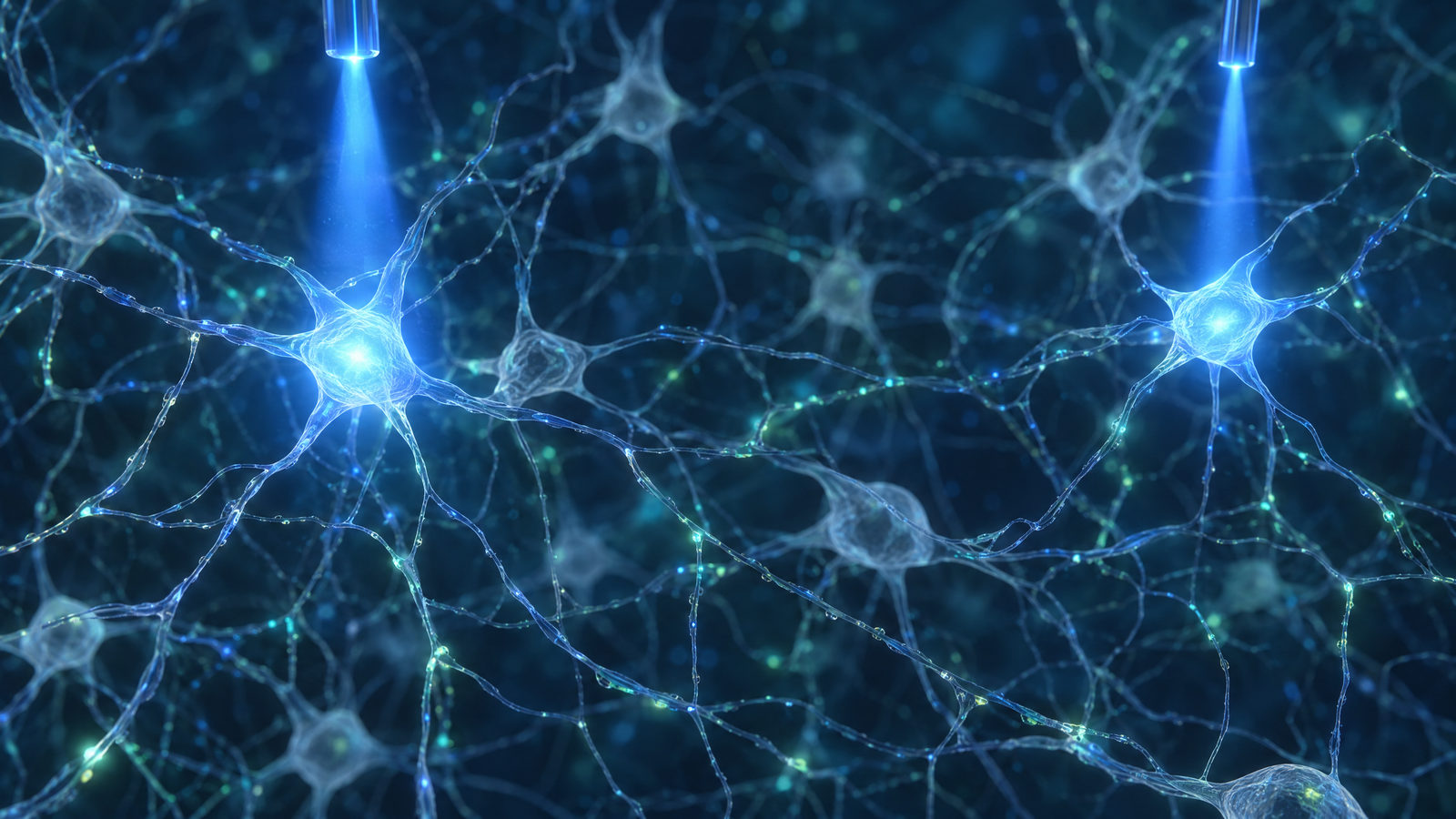

The Nobel Assembly at Karolinska Institutet has awarded the 2026 Nobel Prize in Physiology or Medicine to Karl Deisseroth, Peter Hegemann and Georg Nagel for discoveries concerning light-gated ion channels and optogenetics. Announced on 5 October, the award recognises a method that lets researchers use light to control selected nerve cells and examine how brain circuits contribute to behaviour. The work has changed experimental neuroscience by allowing scientists to test what particular groups of neurons do, rather than merely observe which areas become active.
The technique began with channelrhodopsin, a light-sensitive protein identified by Hegemann and Nagel in the single-celled alga Chlamydomonas. In the alga, the protein helps convert light into an electrical response. When the gene that encodes it is introduced into a nerve cell, the cell can become responsive to a chosen wavelength of light. Illumination opens the protein’s ion channel, allowing charged particles to cross the cell membrane and trigger electrical activity. Deisseroth and colleagues demonstrated that this could activate rat nerve cells in 2005, then showed control in the brains of living mice in 2007.
That combination of genetics and optics gave optogenetics its name and distinctive power. Researchers can target a defined cell type or connection, then use brief pulses of light to change its activity while an animal behaves. Comparing behaviour when a circuit is activated or inhibited can help test whether it contributes to a memory, movement or emotional response. Earlier tools could identify correlations between brain activity and behaviour, but often could not isolate cause and effect with the same precision. The method therefore opened a new way to investigate how distributed neural circuits work.
Since its development, optogenetics has become a widely used research approach across neuroscience and biology. Studies have used it to examine circuits linked to sleep, movement, memory and conditions including epilepsy, Parkinson’s disease, schizophrenia and addiction. Its value is not that it provides a complete map of the brain, but that it gives investigators a controlled way to perturb selected parts of a living system and observe what changes. That can help researchers refine questions about disease mechanisms and identify which cells or pathways merit further study.
The award also brings attention to possible medical applications, but the distinction between a laboratory tool and a treatment is important. Researchers are investigating whether light-sensitive proteins could help restore some visual function in people with retinal disease by making surviving cells respond to light. Such work involves delivering genetic material and is still under development; it is not an established treatment or a general cure for blindness. Most proposed clinical uses remain investigational, and further testing is needed to establish safety, benefit and which patients might be suitable.
There are practical limits even in research. Scientists must get the relevant genetic instructions into the right cells and deliver light to the target tissue, often using specialised optical equipment. The method is most straightforward in experimental settings where cells can be genetically modified, which constrains how it can be used in people. It can reveal the function of selected circuits under particular conditions, but results from animal studies do not by themselves show that the same intervention will be safe or effective in human patients.
The three laureates will share the prize of 12 million Swedish kronor equally. The recognition joins two steps that made the field possible: finding a naturally occurring light-gated ion channel and adapting it to control neurons. By turning a biological response to light into an experimental switch, their work has provided neuroscientists with a precise way to study how brain activity relates to action and experience, while leaving a clear boundary between new insight and proven clinical care.