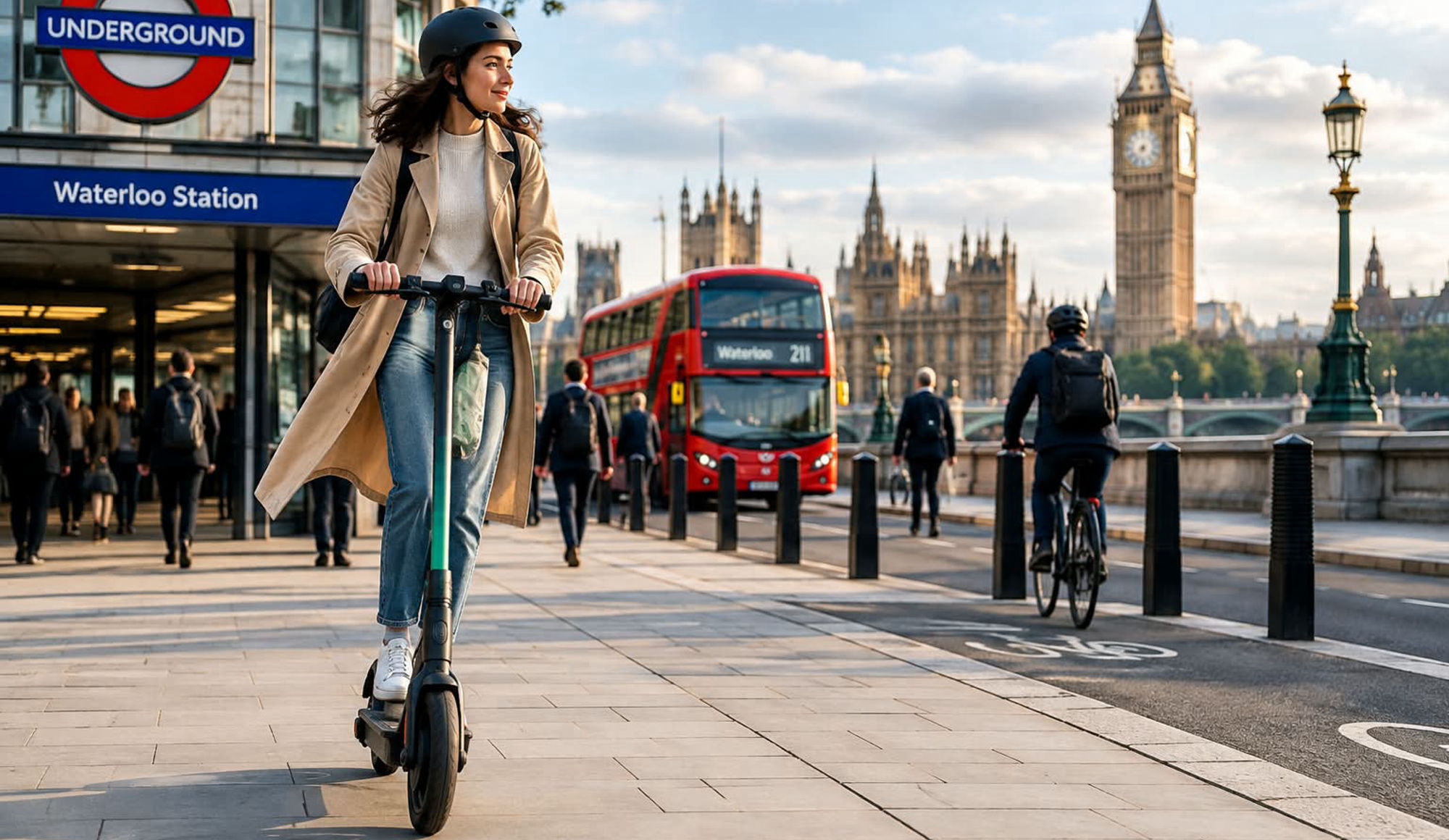

Anyone who has stood on a packed platform at Waterloo during rush hour, or sat in bumper-to-bumper traffic on a two-mile drive that should take ten minutes, knows the problem well. Short journeys in UK cities are often the most frustrating part of the day. They’re too short to justify a car, too long to enjoy walking in the rain, and just awkward enough that public transport feels like overkill for the distance involved.
It’s a gap that has put electric scooters for urban travel firmly on the transport agenda, even though, as things stand, their role in the UK is more limited than it might first appear.
The “Last Mile” Problem Isn’t New, But It’s Getting Worse
Urban planners have talked about the “last mile” problem for decades: the tricky stretch between a train station or bus stop and someone’s actual destination. In London, Manchester, Bristol, and other major cities, that gap has grown as public transport networks strain under rising demand and rail disruptions become more common.
Councils have tried buses, extra cycle lanes, and even encouraged more walking. But none of these fully solve the problem of getting from A to B quickly when A and B are only a mile or two apart. That’s where electric scooters have quietly carved out a niche.
Why the Appeal Is Growing
Walk through central Bristol or parts of east London on a weekday morning and you’ll spot e-scooters everywhere—mostly the neon-branded ones from local rental schemes, gliding past queued traffic and weaving between cars stuck at junctions. Interest isn’t limited to younger riders either. Office workers, students, and commuters of all ages have taken to rental e-scooters as a practical way to cover short distances where authorised trials operate.
A few reasons keep coming up when people explain the appeal:
Speed through congestion. London Assembly figures for 2024/25 put average bus speeds in the capital at around 9mph, a trend that’s been slowing for several years. A scooter can comfortably keep pace with that over a short, direct route—though actual speeds vary by borough, time of day, and road conditions.
Lower running costs. Where rental schemes operate, per-minute pricing can undercut short taxi fares and avoid car parking charges altogether, though costs add up on longer or more frequent trips.
Compact and portable. Folding designs make personal e-scooters easy to store at home or carry indoors—useful for short trips on private land, even if that portability doesn’t extend to public-road use in most of the UK.
Environmental impact. With more councils setting air quality targets, zero-emission short trips—whether on foot, by bike, or via authorised e-scooter trials—are becoming a bigger part of local transport strategy.
The Current Legal Position in the UK
This is where the picture gets important, and where a lot of confusion still exists.
It is legal to buy, own, and store a private e-scooter in the UK. What’s not legal is riding a privately owned e-scooter on public roads, pavements, or cycle lanes. Under current law, e-scooters are classed as motor vehicles, which means they’re technically subject to the same requirements as cars—MOT, insurance, registration, and a valid licence—none of which a standard consumer e-scooter can actually meet. In practice, this makes private e-scooter use on public land unlawful, and police forces across the country, including in London, Bristol, and the West Midlands, have the power to seize scooters ridden illegally.
The exception is government-backed rental trials, which have been running in dozens of towns and cities since 2020. In these designated areas, riders can legally use an approved rental e-scooter—hired by the app or by the minute from an operator like Voi, Tier, or Lime—provided they hold a valid provisional or full driving licence. These trial scooters are distinct from privately owned ones: they’re insured by the operator, registered with the scheme, and restricted to specific zones.
The Department for Transport has said it intends to bring forward wider e-scooter legislation, and the outcome of the ongoing trials will likely shape whatever rules come next. But as of now, no general legalisation of private e-scooter use on public roads has taken effect, and riders should not assume otherwise. Anyone buying a private e-scooter today should plan to use it on private land, with the landowner’s permission, unless and until the law changes.
Not a Silver Bullet, But a Useful Piece of the Puzzle
It would be a stretch to say electric scooters are going to replace buses, trains, or even bikes anytime soon. They work best for what they’re designed for: short, direct trips where speed and convenience matter more than carrying capacity or long-distance range.
For someone commuting five miles each way, a scooter alone probably isn’t the answer. But for the person who needs to get from a train station to their office, or from home to the local high street, it often beats every other option on the table.
That’s really the shift happening in UK cities right now. Transport planning is moving away from one-size-fits-all solutions and toward a mix of options that people can combine depending on the trip. A train for the long stretch, a scooter for the final leg. It’s less about replacing existing infrastructure and more about filling the cracks between it.
What This Means for UK Commuters Right Now
The honest answer is: it depends where you live, and what you’re using the scooter for. If you’re in one of the towns or cities running an official rental trial, an e-scooter can genuinely solve the last-mile problem for a fraction of the cost of a taxi. Outside those zones, or with a privately owned scooter, the legal reality is much narrower—private-land use only, with no route to the daily public-road commute many people picture when they buy one.
That distinction matters more than the marketing around e-scooters sometimes suggests. Battery life, build quality, and safety features have all improved significantly in recent years, which is good news for the trials and for private use on private land. But better hardware doesn’t change the law, and anyone considering a private e-scooter should go in with clear eyes about where they can and can’t ride it.
For now, the more realistic short-term shift is happening within the rental trial areas, where local authorities have reported growing familiarity and uptake as schemes mature, though exact figures vary by city and aren’t uniformly published. Whether that translates into wider legalisation of private e-scooters will depend on how the government interprets the trial data—and until then, the safest and only legal option for private ownership is to keep it off public roads and pavements entirely.