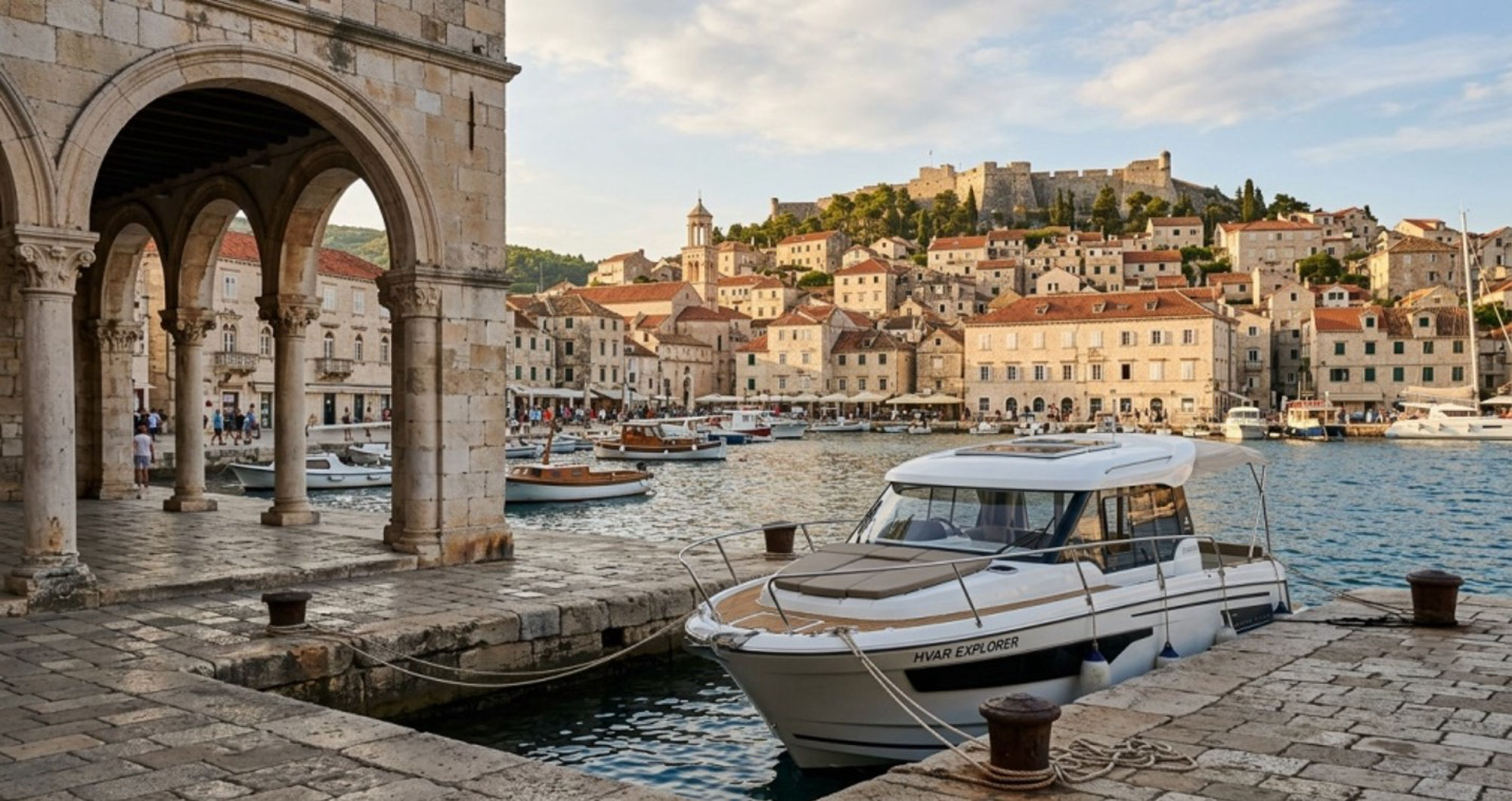

Hvar’s history stretches back further than almost anywhere else on the Adriatic coast, layered with the influence of Greek colonists, Illyrian tribes, Roman administrators, Venetian rulers, and eventually the Austro-Hungarian Empire, each leaving a distinct mark on the island’s towns, architecture, and culture.
Ancient beginnings
Long before the Greeks arrived, Hvar was inhabited by Illyrian tribes, with archaeological evidence of settlement dating back thousands of years, including notable Neolithic finds in Grapčeva Cave. In 384 BC, colonists from the Greek island of Paros established the settlement of Pharos on the site of modern Stari Grad, laying out the surrounding agricultural plain in a geometric grid system that remarkably survives to this day, now recognised as a UNESCO World Heritage site.
Roman and Byzantine periods
Following Greek settlement, the island came under Roman control, integrated into the broader province of Dalmatia. Roman-era remains can still be found scattered across the island, though less prominently than the Greek agricultural legacy. As the Roman Empire fractured, Hvar passed through Byzantine control before entering a turbulent medieval period marked by shifting allegiances among competing regional powers.
The Venetian era
Hvar’s most architecturally significant period came under Venetian rule, beginning in the early 15th century and lasting nearly four centuries. It was during this time that Hvar Town was developed as a key naval base, strategically positioned along Venice’s Adriatic shipping routes. The Venetians built the Arsenal, the public theatre (one of Europe’s oldest), and fortified the town against Ottoman incursions with the construction of the Spanish Fortress above the harbour. This period established Hvar as a genuinely important cultural and commercial centre, not merely a fishing outpost, and much of the architecture visitors admire today dates from this era.
Ottoman threats and fortification
Throughout the 16th century, Hvar faced repeated threats from Ottoman raids, prompting the construction and reinforcement of defensive structures across the island. The 1571 sack of Hvar Town by Ottoman forces, following the larger regional conflicts of the era, led to significant rebuilding and further fortification, shaping the town’s defensive layout that remains visible today.
Austrian and later rule
Following the fall of the Venetian Republic in 1797, Hvar passed briefly under French control before becoming part of the Austrian Empire, remaining so until the end of the First World War. This period saw the beginnings of tourism infrastructure, including the establishment of one of Europe’s first tourist associations in Hvar Town in 1868, an early sign of the island’s future direction.
The 20th century and tourism’s rise
After the World Wars and the establishment of Yugoslavia, Hvar’s economy gradually shifted from traditional agriculture and fishing toward tourism, a transition that accelerated dramatically following Croatia’s independence in the 1990s. The island’s combination of historic architecture, favourable climate, and dramatic coastline made it a natural draw for the yachting and luxury tourism sectors that now define much of its summer economy.
History meets the modern coastline
Understanding Hvar’s layered past adds considerable depth to a visit, transforming what might otherwise be simply a beautiful beach destination into a place with genuine historical weight. Many visitors combine time spent exploring this history in Hvar Town and Stari Grad with days on the water, and looking into Hvar boat rental options makes it easy to see the coastline much as ancient sailors would have, approaching the island’s fortified harbours from the sea. Few places along the Adriatic offer such a complete, physically walkable timeline spanning over two thousand years of continuous history.
Preserving the past amid growth
As tourism has grown into Hvar’s dominant industry, local authorities and heritage organisations have worked to balance development with preservation, particularly within Hvar Town’s protected Old Town core and the UNESCO-listed Stari Grad Plain. Strict building regulations limit modern construction within these historic zones, which is part of why the architecture visitors see today remains so consistent with descriptions and depictions from centuries past. Visitors who take the time to learn even a little of this history before arriving tend to notice far more during a walk through either town than those who simply see the stone streets as a scenic backdrop.