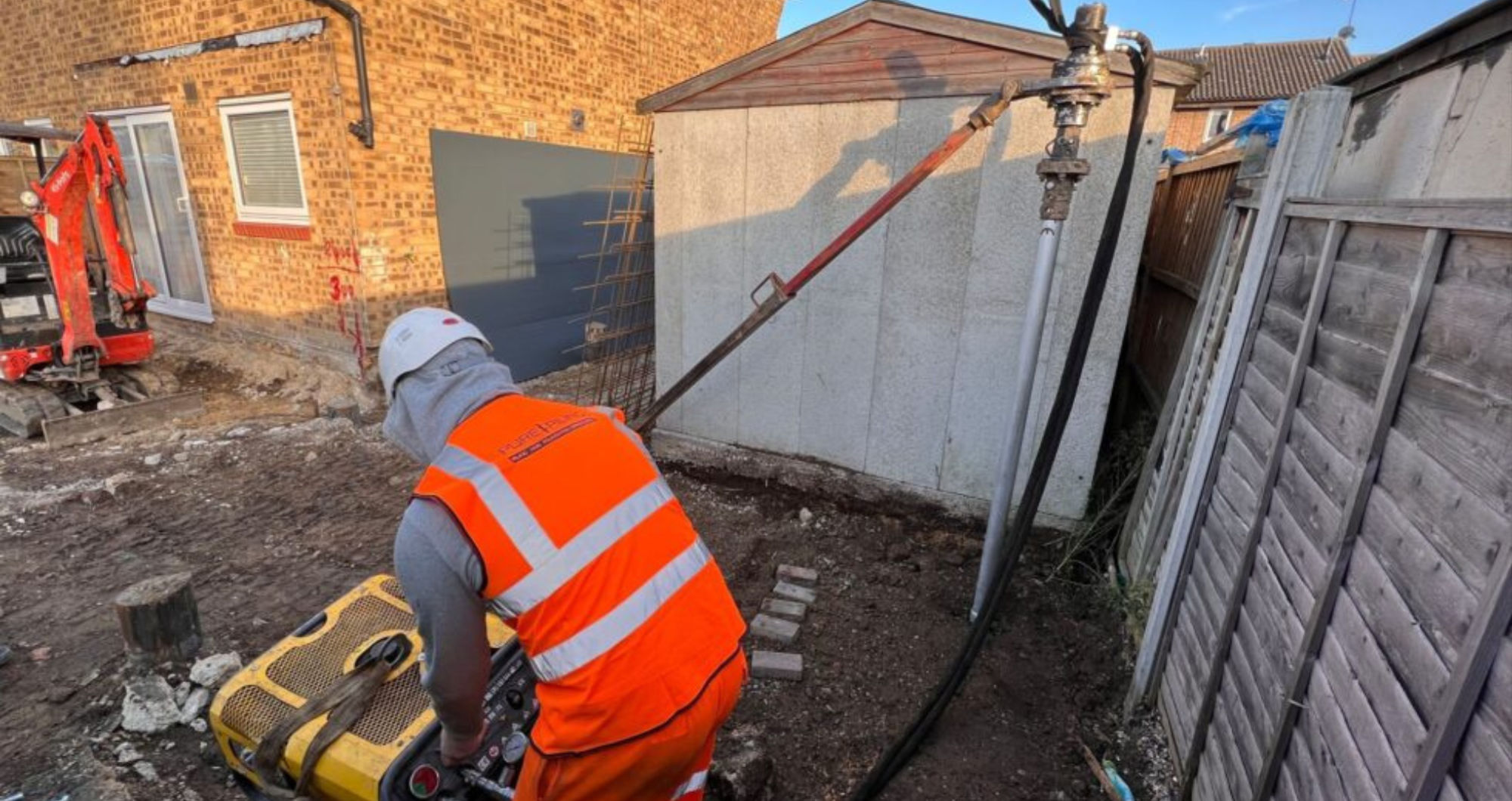

The first thing most homeowners hear of piling is a line on a structural engineer’s drawing, or a phone call from the builder on the day the trial hole goes in. The trench has been dug, the ground is not what anyone hoped, and the strip foundation that was priced in the quote is no longer going to be enough. Somebody says the word piles, and the budget conversation begins.
It is worth understanding why this happens so often in the South East, what the alternatives are, and what a piling job actually looks like in a back garden.
The ground around London moves
Most of Essex and the eastern side of London sits on clay. London Clay in particular is a shrinkable soil: it swells when wet and shrinks when dry, and the top metre or two can move noticeably between a wet winter and a dry summer. A conventional strip foundation sits in that top layer and moves with it, which is fine for a house that has been settling for a century and much less fine for a new extension bolted onto it.
Trees make it worse. An oak, a poplar or a willow within twenty metres of a new foundation will draw water out of the clay in summer and leave it to swell back in winter. Building control takes this seriously, and a foundation near a large tree on clay can be required to go three metres deep or more. At that depth, a trench is dangerous, slow and expensive to pour, and the arithmetic swings in favour of piles.
Drains and existing structures push the same way. A foundation that would cut across a public sewer, or sit next to a neighbour’s wall that cannot be undermined, often has to go deep in a narrow footprint, and that is exactly what a pile does.
What a pile is
A pile is a column of concrete, sometimes with a steel core, driven or bored into the ground until it reaches a layer that can carry the load. Instead of spreading the weight of the building across a wide, shallow trench, it carries it down past the moving clay to something stable. A ground beam then runs between the pile heads, and the walls of the extension sit on the beam.
For domestic work, the rigs are small, which is the part people do not expect. Mini piling rigs are built to fit through a standard side gate and work in a garden where a large machine could never go. They bore or drive piles of 150mm to 300mm diameter to depths of 6 to 15 metres, and a typical rear extension needs somewhere between eight and sixteen of them.
What it is like on the day
A mini piling job for an extension is usually two to four days of rig work. The rig arrives on a trailer, is tracked into position, and bores or drives each pile in turn. Driven piles are noisier; bored piles are quieter and produce spoil that has to be removed. Neighbours should be warned either way, because the vibration from a driven pile travels through clay in a way that is unsettling the first time you feel it.
Once the piles are in, the contractor will usually form the ground beams and the slab as well, so the builder arrives to a finished base. Anyone talking to mini piling contractors in Essex should ask whether the quote covers the beams and slab or just the piles, because the two are often quoted separately and the beams are not a small item.
The paperwork
Piling is a designed element. The structural engineer specifies the pile type, depth, and layout from a site investigation, which may be as simple as a trial pit and a hand auger or as thorough as a borehole with laboratory testing. Building control will want to see the design and may want to witness the piles going in. The contractor should provide a piling record for every pile: its position, depth, the ground it reached, and the load it was designed for. Keep it with the house documents, because a future buyer’s surveyor will ask.
What it costs, honestly
Piles cost more than a shallow strip foundation and less than a very deep one. The crossover point is usually somewhere around two metres of trench depth. Below that, the trench needs shoring, pumping and a great deal of concrete, and the pile becomes the cheaper option as well as the safer one. The engineer’s drawing will tell you which side of the line a particular site falls, and it is worth having that conversation before the builder’s quote is fixed rather than after the trench is open.
An extension on piles is not a compromised extension. It is one that will still have straight door frames in thirty years, which on clay is not something a shallow foundation can promise.