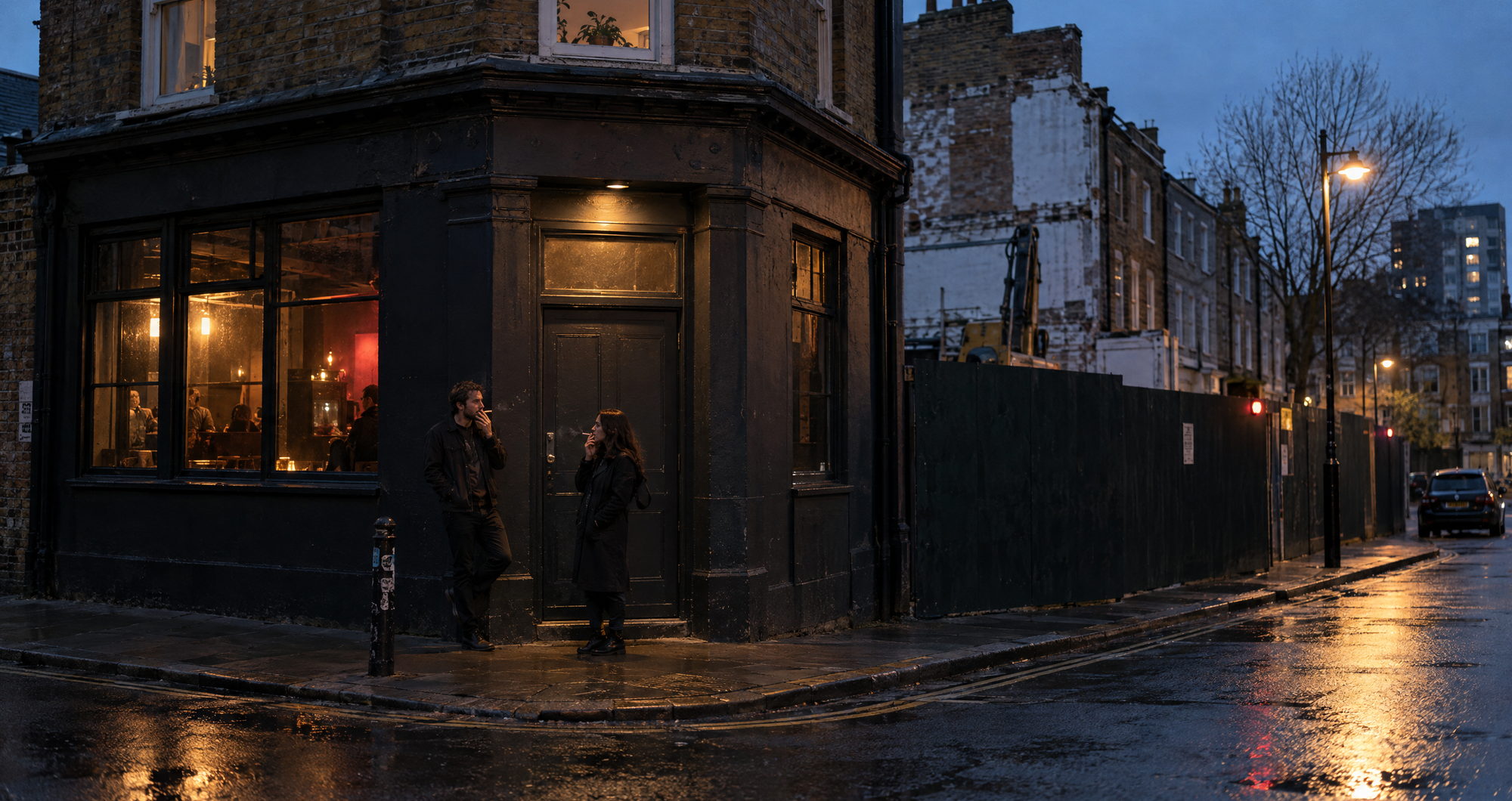

Hackney Council refused planning permission on Thursday 5 November 2026 for seven flats and a ground-floor commercial unit on Morning Lane, next to the Moth Club. It is the second time the council has turned down a scheme on the site, and the decision protects a live music and comedy venue that has operated since 1972.
Planners concluded that the applicant, the developer Ganatra, had failed to demonstrate that the proposed development would not give rise to undue noise and disturbance for future occupiers. Officers also found no provision for affordable housing and concluded that the scheme would fail to contribute to mixed and balanced communities. The decision notice sets out both grounds, and neither concerns the size or massing of the proposed building.
An earlier application from the same developer, for six apartments, was refused in March 2026. The second scheme added one flat to the first and kept a commercial unit at ground level.
A petition in support of the venue gathered more than 36,000 signatures. It was backed by Hackney Nights, Save Our Scene, the NTIA and the Music Venue Trust, organisations that campaign on the night-time economy and on grassroots music venues.
The size of the petition does not itself determine an application. The council’s stated reasons are confined to noise and affordable housing rather than to the venue’s cultural value. Neither point depends on how long the club has traded.
Noise and affordable housing
The refusal rests on two tests that apply to any scheme built beside an established music venue. The first is acoustic: an applicant has to show that people living in new homes next to amplified music will not be exposed to unreasonable noise. That test concerns the future occupiers of the flats rather than the venue, which has operated on the street since 1972.
The second test is the affordable housing requirement, which this application did not address at all.
Both matters appear in the officers’ reasoning rather than as findings against the developer personally, and the application was refused on those grounds. Neither objection is novel: the same two issues were live when the earlier scheme was turned down in March.
The club’s founder, Keith Miller, thanked supporters, the council and its planning department for their diligence. The club said it would honour a promise to hold a party on a scale it has not staged before. The venue opened in 1972 as a servicemen’s club and has since become one of the best known small stages in the borough.
What happens next
With both applications now refused, the position on Morning Lane is unchanged in planning terms. No consent exists for residential development on the adjacent site, and the venue continues to operate.
A revised scheme would have to answer the same two objections, with acoustic evidence covering the proposed flats and an affordable housing offer that the previous applications lacked. Until an applicant produces both, the council’s stated reasons give it a consistent basis for refusal, and the venue has the benefit of that in the meantime.
For the venue, the immediate threat of residential neighbours has receded for a second time. For the developer, the site remains undeveloped. For the council, the two refusals set a local position that noise and affordable housing are the tests for schemes beside venues. That position has not yet been tested by an application that answers both.