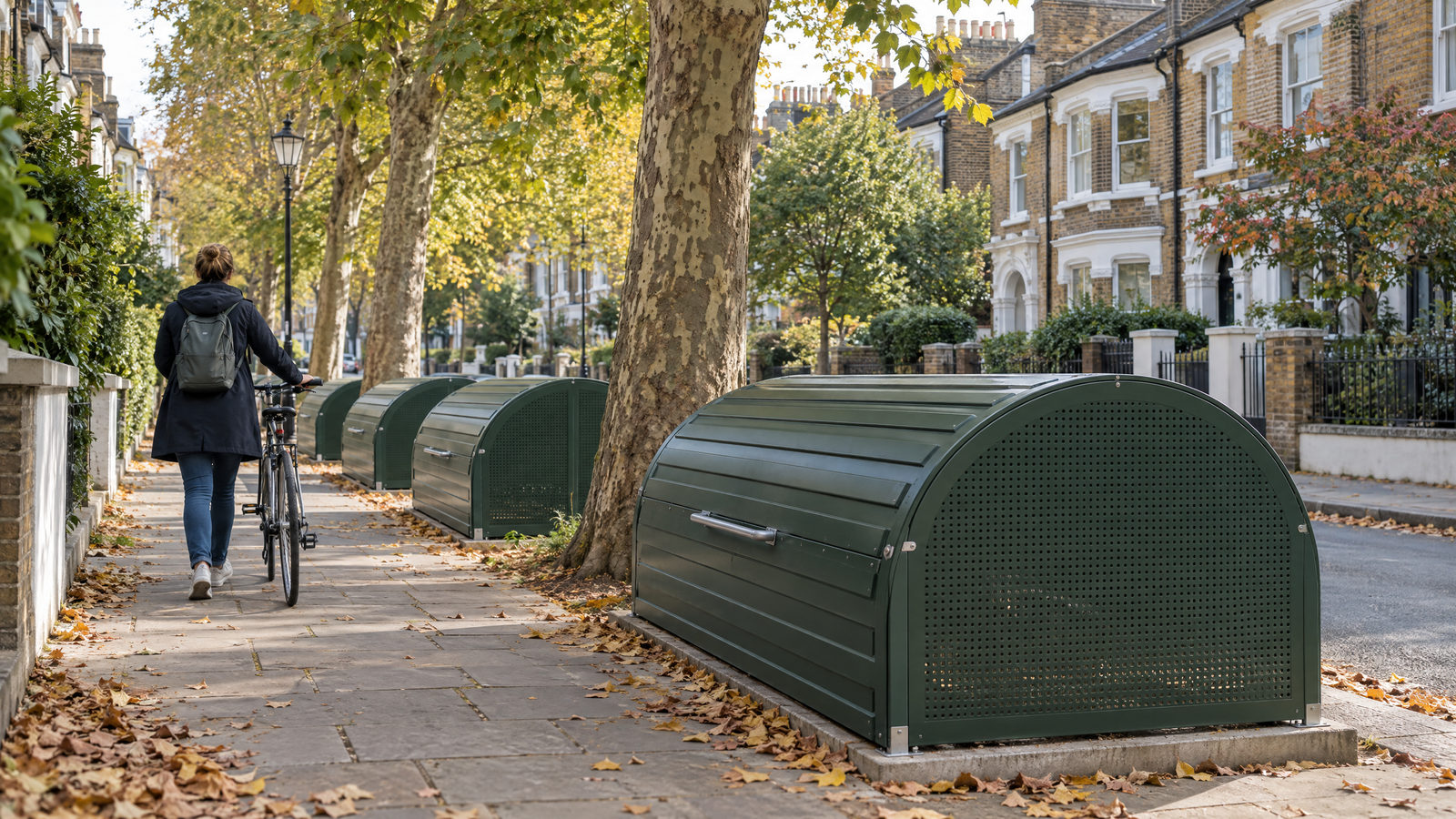

Islington Council has approved a procurement strategy that could bring up to 691 additional bike hangars to streets and council estates over the next seven years, subject to a call-in period that runs until 29 September.
The decision, made on 24 September by the council’s Director of Public Realm, Climate Change and Transport, authorises officers to seek a supplier for the supply, installation and repair of the hangars. The proposed agreement has a maximum value of £3,269,274. It is a decision to begin the procurement process, rather than an award to a named contractor or a guarantee that every unit will be installed.
That distinction matters for residents watching for a hangar near home. The council can order up to 100 on-street units and 30 estate units in a year under the proposed arrangement, but the supplier would not be guaranteed a minimum volume. Actual delivery will depend on demand, approvals and the money available in each year.
The plan is split between an estimated 598 on-street hangars and 93 on council estates. The on-street element is intended to expand secure storage on residential roads; estate provision is also linked to the need to keep bicycles out of shared internal areas where fire-safety requirements apply. The figures are maximum planned volumes, not a count of sites already approved.
Islington already has a sizeable network. Council papers put the May total at 657 on-street hangars, with room for 3,942 bicycles, alongside 349 secure cycle stores on estates. Of the estate stores, 186 are hangars. The new procurement therefore builds on an existing service rather than creating a new one from scratch.
For people who rent a space on the street, the decision does not alter the annual charge. It remains £107.25, while estate hangars are intended to remain free to residents. The council’s material says that the on-street charge is used to meet running costs including repairs, cleaning and the administration of subscriptions.
Where new units go will be just as important as the total number bought. The council says on-street sites are expected to follow demand from its waiting list, while taking account of whether another hangar is already nearby. Before an on-street unit is installed, the proposed process includes engagement with ward councillors, public consultation and a traffic order. That means the procurement approval does not settle every individual location.
The programme also carries some practical constraints. A hangar occupies part of a parking bay, so local consultation will remain relevant in streets where kerb space is tightly contested. The council’s published information reports average occupancy of about 70 per cent for street hangars and 61 per cent on estates. Those figures indicate that expanding capacity will need to sit alongside work to match new installations to the places where secure storage is most wanted.
Financially, the maximum value is not all described as fully committed spending. The council’s planning material separates the street and estate elements, with some estate funding identified and other anticipated contributions not yet allocated. The structure of the proposed agreement allows the council to scale orders according to funding and demand instead of committing immediately to all 691 hangars.
The decision is currently subject to call-in. The council’s decision record showed no call-ins when it was published. If no call-in is made by 29 September, the decision is due to take effect on 30 September. Officers would then be able to take the procurement forward, but a successful tenderer, final installation schedule and the streets receiving the first units have not yet been announced.
For residents, the immediate development is a longer-term route to more secure cycle storage, not an instruction to expect a new hangar outside a particular home this autumn. The next visible milestones will be the outcome of the tender and the site-by-site consultation process.